Infosys Certified MS SQL Server Developer
Practice with real exam-pattern questions for Infosys Certified MS SQL Server Developer. Each question includes a detailed explanation to help you understand the concept, not just memorise the answer. Try 10 questions free — no login required.
Full question bank for this exam + 1,357+ others. Cancel anytime.
Join Premium10 Infosys Certified MS SQL Server Developer practice questions with answers
Real Lex exam-pattern multiple-choice questions for the Infosys Certified MS SQL Server Developer certification. Each question includes the correct answer. The full question bank is available to Premium members.
- Question 1
Consider the following data in two table
LoanDetails:
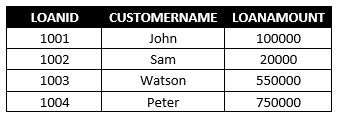
EMIPaymentdetails:
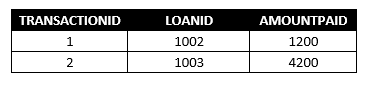
What will be the output on executing the below code?
MERGE LoanDetails AS LD
USING EMIPaymentDetails AS EMI
ON LD.Loanid = EMI.Loanid
WHEN MATCHED THEN
UPDATE SET LoanAmount = LoanAmount-EMI.Amountpaid
WHEN NOT MATCHED THEN
UPDATE SET LoanAmount = LoanAmount+1500;
- ✓4 rows will be updatedCorrect
- BError. Update is not allowed in the WHEN NOT MATCHED condition
- C2 rows will be updated
- DError. MATCHED condition can’t update the target Table
- Question 2
Which of the following statements are TRUE with respect to temporary tables? CHOOSE TWO CORRECT OPTIONS.
- ✓Global Temporary tables can be shared between concurrent connectionsCorrect
- BTransactions in tempdb are logged and hence data in temporary tables can be rolled back
- CBy default both private and global temporary tables will be created in master database
- DPrivate temporary tables can be accessed across multiple sessions of same user
- Question 3
A company XYZ has a requirement to host database of 4 different applications on 4 different SQL Instances.
Accordingly the computer department of the organization installed 4 instances of SQL SERVER to meet the requirement on a single machine.
Identify the number of default and named instances present on the machine.
- ✓two Default and two Named instancesCorrect
- Bthree Default and one Named instance
- Cone Default and three Named instances
- Dzero Default and four Named instances
- Question 4
Which of the following statement is true about temporary table?
- ✓Local temporary table should be prefixed with ‘##Correct
- BGlobal temporary table is stored in master database
- CLocal temporary table is created be default
- DTemporary tables (local or global) are stored in tempdb database
- Question 5
Which of the following DML operations can be performed by MERGE in SQL Server?
- ✓Only INSERTCorrect
- BOnly INSERT and UPDATE
- COnly INSERT and DELETE
- DINSERT, UPDATE and DELETE
- Question 6
State whether the below mentioned statements with respect to data types are True or False?
- NVARCHAR is used to store Unicode characters
- TINYINT can be used to store the phone number which has 10 digits
- ✓Both statements are trueCorrect
- BOnly statement ii is true
- COnly statement i is true
- DBoth statements are false
- Question 7
John has created the following table in SQL Server:
CREATE TABLE Trainee (
TraineeId INT CONSTRAINT pk_TraineeId PRIMARY KEY,
Name VARCHAR(20) NOT NULL )
He now wants to create a clustered index on the column Name.
Jack says, it is currently not possible as there is already a clustered index in the table.
Jill says, it is possible, only if the clustered index is created after the Primary Key Constraint is dropped.
Which of the following statements is true?
- ✓Jill's statement is correctCorrect
- BJack's statement is correct
- CBoth the statements are correct
- DBoth the statements are incorrect
- Question 8
A table Student (SID, Sname, Course, Grade) where SID has a Unique Constraint is created successfully.
Tony and Steve is having the following discussion:
Tony says we can create Clustered index on column SID
Steve says we can create Non-Clustered Index on column SID
Identify whose statement is correct
- ✓Steve is correctCorrect
- BTony is correct
- CBoth are correct
- DNone of them are correct
- Question 9
Consider a Customer table created as shown below
CREATE TABLE Customer
(
     CustomerId INT CONSTRAINT pk_CustomerId PRIMARY KEY
     CustomerName VARCHAR(250) NOT NULL,
)
GO
What would be the output when the below query gets executed
Query 1: CREATE INDEX idx1 ON Customer(CustomerId)
Query 2: CREATE INDEX idx2 ON Customer(CustomerName)
- ✓Query 1 will throw an error as the CustomerId column already has an indexCorrect
- BQuery 2 will throw an error as we can’t create an index on CustomerName column
- CBoth queries get executed successfully and non-clustered indexes created on CustomerId and CustomerName columns
- DBoth queries get executed successfully and no indexes are created
- Question 10
What would happen when the below SQL script gets executed?
CREATE TABLE Emp ( EmpId INT PRIMARY KEY, EmpName VARCHAR(30) )- ✓Emp table is created with clustered index on EmpId ColumnCorrect
- BEmp table is created with non-clustered index on EmpId column
- CEmp table is created with no index
- DEmp table is created with clustered and non-clustered index on EmpId column
More in Microsoft
Infosys Certified Dynamics 365 ERP Fundamentals
Infosys Certified Dotnet Core Web API Developer
Infosys certified Microsoft Azure Cloud Native Application Developer
Pay once. Clear every cert this year.
One subscription, full Telegram channel access, every PDF posted during your membership.
- Full access to all 1,357+ certifications
- Monthly updated question banks
- Telegram private channel access
- Cancel anytime
- Everything in Monthly
- Save ₹2,100 vs monthly billing
- Priority answer key requests
- Best for increasing DQ score fast
- Everything in Quarterly
- Lifetime channel access — no renewals
- All future certifications included
- Priority response from admin team
Common questions, straight answers.
A monthly-updated Telegram channel where we post real exam-pattern question banks and detailed answer keys for 1,357+ Infosys Lex certifications. You join once, you get every PDF posted during your membership.
Right after payment on our Graphy page, you'll receive a private invite link to the Telegram channel. Access is instant — usually under 30 seconds.
We compile question banks from the actual Lex test pattern, sourced and verified by 180K+ community members who've recently cleared these exams. Match rate is consistently 85–95%.
Every single month. When Infosys rolls out new versions of certifications, we post updated dumps within 7–10 days. You'll see channel activity weekly.
Clearing certifications is one of the highest-weighted DQ factors. Members typically clear 3–5 certifications in their first 3 months, which moves DQ scores up by a full band.