Infosys Certified Oracle Database Administrator - Beginner
Practice with real exam-pattern questions for Infosys Certified Oracle Database Administrator - Beginner. Each question includes a detailed explanation to help you understand the concept, not just memorise the answer. Try 10 questions free — no login required.
Full question bank for this exam + 1,357+ others. Cancel anytime.
Join Premium10 Infosys Certified Oracle Database Administrator - Beginner practice questions with answers
Real Lex exam-pattern multiple-choice questions for the Infosys Certified Oracle Database Administrator - Beginner certification. Each question includes the correct answer. The full question bank is available to Premium members.
- Question 1
Which of the following scenarios requires a FULL OUTER JOIN?
- ✓You want to find all employees who either have a project assigned or not assigned.Correct
- BYou need to find unmatched rows from both employee and department tables.
- CYou want to find matching rows only from both tables.
- DYou want to include all rows from one table, regardless of matching conditions.
- Question 2
If a query uses both GROUP BY and ORDER BY, which operation is performed FIRST?
- ✓ORDER BY is performed before GROUP BYCorrect
- BGROUP BY is performed before ORDER BY
- CBoth are performed simultaneously
- DThe execution order depends on the database engine
- Question 3
A query uses both GROUP BY and HAVING. Which of the following statements is TRUE?
- ✓GROUP BY is used to filter data after the HAVING clauseCorrect
- BHAVING can filter grouped data, whereas GROUP BY aggregates the data
- CHAVING must include all columns listed in GROUP BY
- DGROUP BY cannot work without a corresponding ORDER BY
- Question 4
In an ER diagram, a library tracks books and borrowers. Each book can be borrowed by multiple borrowers, and each borrower can borrow multiple books. What kind of relationship does this represent?
- ✓One-to-oneCorrect
- BOne-to-many
- CMany-to-many
- DMany-to-one
- Question 5
In an ER diagram, what is the relationship between a student and their enrolled courses if each student can enroll in multiple courses and each course can have multiple students?
- ✓One-to-oneCorrect
- BOne-to-many
- CMany-to-many
- DMany-to-one
- Question 6
A table contains repeating groups of data. What should be done to normalize this table to 1NF?
- ✓Remove multivalued attributes into separate tablesCorrect
- BEliminate partial dependencies by creating separate tables for each functional dependency
- CRemove transitive dependencies by ensuring non-key attributes depend directly on the primary key
- DSplit the table to ensure no overlapping candidate keys
- Question 7
Assume that the "employee" table has already been created. Which of the following SQL statements correctly creates a "project" table with constraints referencing the "employee" table?
- ✓a) CREATE TABLE project ( project_id INT PRIMARY KEY, project_name VARCHAR(100) NOT NULL, employee_id INT, FOREIGN KEY (employee_id) REFERENCES employee(employee_id));Correct
- Bb) CREATE TABLE project ( project_id INT PRIMARY KEY, project_name VARCHAR(100) NOT NULL, employee_id INT, CONSTRAINT fk_employee FOREIGN KEY (employee_id) REFERENCES employee(employee_id) ON DELETE CASCADE);
- Cc) CREATE TABLE project ( project_id INT PRIMARY KEY, project_name VARCHAR(100) NOT NULL, employee_id INT NOT NULL, CHECK (employee_id IN (SELECT employee_id FROM employee)), FOREIGN KEY (employee_id) REFERENCES employee(employee_id));
- Dd) CREATE TABLE project ( project_id INT PRIMARY KEY, project_name VARCHAR(100) NOT NULL, employee_id INT, CONSTRAINT FOREIGN KEY (employee_id) REFERENCES employee(employee_id));
- Question 8
Which of these are types of SQL used for querying and modifying data? Select the CORRECT option.
- ✓Data Manipulation LanguageCorrect
- BData Definition Language
- CQuery Assertion Markup Language
- DTransaction Control Language
- Question 9
Consider the table engineer given below:
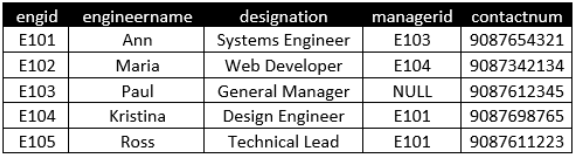
Query:
SELECT e1.engid FROM engineer e1 INNER JOIN engineer e2 ON e1.managerid=e2.managerid
WHERE e1.engineername LIKE '%a%' AND e1.engid<>e2.engid;What will be the managerID of the engineer who is extracted from the execution of the above Query?
- ✓E101Correct
- BE104
- CE103
- DNULL
- Question 10
Consider the table FlightDetails given below. Determine the number of records displayed for the given query:
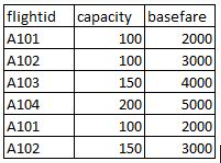
SELECT DISTINCT flightid, capacity, basefare FROM FlightDetails where capacity>100;
- ✓5Correct
- B4
- C3
- D6
Pay once. Clear every cert this year.
One subscription, full Telegram channel access, every PDF posted during your membership.
- Full access to all 1,357+ certifications
- Monthly updated question banks
- Telegram private channel access
- Cancel anytime
- Everything in Monthly
- Save ₹2,100 vs monthly billing
- Priority answer key requests
- Best for increasing DQ score fast
- Everything in Quarterly
- Lifetime channel access — no renewals
- All future certifications included
- Priority response from admin team
Common questions, straight answers.
A monthly-updated Telegram channel where we post real exam-pattern question banks and detailed answer keys for 1,357+ Infosys Lex certifications. You join once, you get every PDF posted during your membership.
Right after payment on our Graphy page, you'll receive a private invite link to the Telegram channel. Access is instant — usually under 30 seconds.
We compile question banks from the actual Lex test pattern, sourced and verified by 180K+ community members who've recently cleared these exams. Match rate is consistently 85–95%.
Every single month. When Infosys rolls out new versions of certifications, we post updated dumps within 7–10 days. You'll see channel activity weekly.
Clearing certifications is one of the highest-weighted DQ factors. Members typically clear 3–5 certifications in their first 3 months, which moves DQ scores up by a full band.